Cutesy Honey: A Designer’s Real-World Embroidery Review
First Impressions: Sweet, Not Saccharine
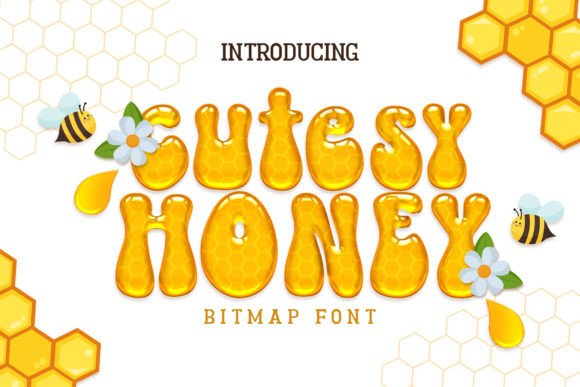
When I opened Cutesy Honey for the first time—intending to use it on a batch of custom embroidered baby onesies—I paused. It wasn’t just “cute.” It had warmth, rhythm, and subtle personality in every curve. The letterforms feel hand-drawn but intentional: rounded terminals, soft joins, and gentle variations in stroke weight that suggest playfulness without sacrificing legibility. As a color font, Cutesy Honey relies on layered fills and textures to deliver its charm—not just outlines or monochrome shapes. That matters deeply in embroidery, where color isn’t optional; it’s structural.
A Real Project Test: Hand-Embroidered Tote Bags for a Local Boutique
Last month, I used Cutesy Honey to design a limited run of linen tote bags for a neighborhood gift shop. The brief was simple: “friendly, handmade, joyful—but not childish.” We chose “Honey” as the focal word (a nod to the shop’s local beekeeping theme), stitched front-and-center in 3.5-inch height. What stood out wasn’t just how it looked on screen—it was how it translated under needle and thread.
The design held up beautifully on medium-weight linen with tear-away stabilizer. Satin stitch elements stayed crisp, fill areas remained breathable (no puckering), and the subtle color shifts—soft yellows, warm creams, and muted corals—translated into rich, cohesive thread palettes. Customers didn’t just notice it—they smiled. One returned twice just to ask about the font. That kind of quiet resonance is rare. It means Cutesy Honey doesn’t shout; it invites.
Where It Shines (and Where It Asks for Care)
Cutesy Honey excels in projects where authenticity and approachability are part of the product’s value: personalized baby blankets, boutique aprons, holiday tea towels, embroidered patches for craft fairs, and small-batch sweatshirt collections. Its visual warmth makes it ideal for Etsy sellers positioning handmade goods as thoughtful, not mass-produced.
That said, it’s not universally forgiving. On stretchy fabric like cotton jersey, the delicate curves and thin interior details need extra stabilization—especially around letters like “e” or “a,” where enclosed counters can collapse if stitch density isn’t balanced. On dark fabrics, the lighter color layers may require slightly higher thread contrast or a white underlay to retain clarity. And on curved surfaces—think caps or pillow gussets—the letter spacing and baseline alignment should be reviewed in a hoop-sized mockup before stitching.
Design Integrity Meets Commercial Reality
As someone who sells digital embroidery files and consults with small craft businesses, I pay close attention to how a design affects perceived value. Cutesy Honey elevates a simple “Thank You” on a kitchen towel into something memorable—not because it’s flashy, but because it feels considered. That builds trust. Buyers associate that care with your brand, whether you’re an Etsy seller bundling printable mockups or a local maker embroidering custom wedding napkins.
It also supports versatility across formats. I’ve used Cutesy Honey successfully in both standalone machine embroidery designs and as part of layered applique designs—its shapes lend themselves naturally to cut-and-stitch workflows. Just remember: when adapting it for applique, simplify interior details manually if needed. Not all color-font nuances survive dense satin borders.
Practical Notes Every Embroiderer Should Check
- Always test on scrap fabric first—especially with textured weaves like burlap or looped terry, where fine lines may disappear.
- Review stitch density before scaling. Enlarging Cutesy Honey beyond 4 inches often requires adjusting fill angles to avoid thread buildup in tight curves.
- Confirm hoop size compatibility. Some versions of color fonts include multi-hoop variants; verify yours fits your standard 5x7 or 4x4 setup—or plan for re-hooping.
- Inspect small details at actual stitch scale. Letters like “i” and “j” have charming dots—but those dots must be large enough to hold shape after washing. If in doubt, enlarge them by 0.5mm in your editing software.
- Test black-and-white mockups alongside full-color previews. This reveals contrast issues early—critical for buyers browsing on mobile or in low-light settings.
- Use proper stabilizer for your fabric type. Lightweight cutaway works best for knits; medium tear-away suffices for stable wovens like quilting cotton or linen.
- Check licensing before selling finished items or digital embroidery files. Since Cutesy Honey is a color font, commercial use rights may differ from standard outline fonts—review terms carefully, especially for resale of digitized versions.
Fitting Into Your Creative Workflow
Cutesy Honey doesn’t replace workhorse fonts like Arial Rounded or KG Second Chances—it complements them. Think of it as your go-to for moments when emotion matters more than efficiency: a baby’s name on a nursery wall hanging, a heartfelt message on a holiday pillow cover, or the shop name stitched onto a handmade apron sold at a farmers’ market. It adds sincerity without pretense.
For digital product sellers, Cutesy Honey pairs well with neutral background templates—think minimalist SVG bundles or printable embroidery guides. Its distinct voice helps your design assets stand out in crowded Etsy search results, especially for terms like “cute baby embroidery,” “handmade tote bag design,” or “small business branding font.”
Final Thought: Charm With Craftsmanship
Cutesy Honey earns its place not because it’s trendy, but because it behaves like a real tool—not just decoration. It responds well to thoughtful digitizing, respects fabric limitations, and rewards attention to detail. In a world flooded with generic script fonts and over-processed dingbats, that kind of integrity is quietly revolutionary.
If you’re choosing Cutesy Honey for your next embroidery project—whether it’s a single personalized gift or a line of small shop products—do so knowing it carries weight. Not in heaviness, but in intention. And in handmade work, that’s everything.